Secure by Design
Catch design flaws
before they ship.
Most teams discover security gaps right before production, or worse, right after. Alvor is security architecture software that runs the design through a governed workflow: impact scoring, security design reviews, threat modeling, control mapping, and evidence-backed sign-off, before a line of code ships.
STRIDE + MITRE ATT&CK36 framework packsEvidence-backed gates
Who it is for
Three people have to agree before anything ships.
The security architect
Design the system once, in a tool that keeps the decision.
- A real architecture canvas, with named and versioned diagrams
- Threat modelling that builds the control set, STRIDE optional
- Patterns and blueprints with immutable published versions
The engineering lead
Know whose ball it is, and never meet a finding at go-live.
- The control set exists from the threat model onward, with owners and dates
- Four named sign-offs, each with a written decision
- Approved with conditions raises the linked risk automatically
The GRC lead
Design decisions land in the same system as the audit.
- One security control catalogue shared with Compliance
- A branded project PDF: BIA, diagrams, threat tables, sign-off matrix
- Every architecture change after baseline recorded with its reason
The process
From first assessment
to production sign-off
A governed path from assessment to sign-off. Every step has defined inputs, role-based gates, and an immutable event trail. Nothing skips a step.
01
Phase 01
Classify & Assess
Know what you're building
Every project starts with one question: how much security does this actually need? The Business Impact Assessment scores risk across five dimensions (operational, financial, reputational, legal, and health & safety) on a configurable 100-point scale, then classifies the project Low, Medium, or High. That score sets everything downstream: control depth, assurance requirements, and who has to sign off.
Business Impact Assessment100-Point Risk ScoreData Classification
02
Phase 02
Design the Architecture
Security on the canvas
Don't invent your security architecture from scratch. Drop proven patterns onto an interactive canvas (microservices, serverless, data pipelines) and inherit the controls and threat models that took the industry years to codify. Every component, every data flow, every connection is visible and accounted for.
Architecture CanvasSecurity PatternsDrag & Drop Design
03
Phase 03
Threat Modeling
See the attack surface
Every component in your architecture has an attack surface. Alvor anchors threats directly to the components, data flows, and trust boundaries they target using STRIDE, MITRE ATT&CK techniques, and kill-chain phases, with each mitigation linked to the control that addresses it. Coverage, including every unmitigated threat, stays visible. Threats live on the architecture, not buried in a document nobody opens.
STRIDEMITRE ATT&CKKill-Chain Mapping
Explore threat modeling04
Phase 04
Map Controls
Map once, comply everywhere
NIST CSF 2.0, NIST 800-53, ISO 27001:2022, SOC 2, PCI-DSS 4.0, CIS v8: stop mapping the same control into four different spreadsheets. Controls attach to architecture components by classification, then cross-map across the framework library as equivalent, subset, or superset. Satisfy one control, and every standard it touches updates with it.
36 Framework PacksCross-Framework MappingStatement of Applicability
05
Phase 05
Test & Prove
Evidence, not assumptions
Run pen tests, SAST, DAST, vulnerability scans, and compliance audits, then link every finding to the control it validates. Evidence flows into an auditable chain (requirement to test to result to sign-off) with versioned artifacts and integrity hashes. When the auditor asks how you verified a control, the answer is already there, timestamped and traceable.
Assurance ActivitiesVersioned EvidenceFindings Register
06
Phase 06
Approve & Ship
The right people say yes
Four independent approvers (Architect, Assurance, Business Owner, Technical Owner) each review from their own lens. Approve, reject, or request changes with conditions that route the design back a phase. Risk acceptances are documented, and nothing reaches production without every stakeholder's timestamped sign-off. This is where governance becomes permanent record.
Conditional ApprovalsRisk AcceptanceImmutable Audit Trail
The product
What that looks like on screen.
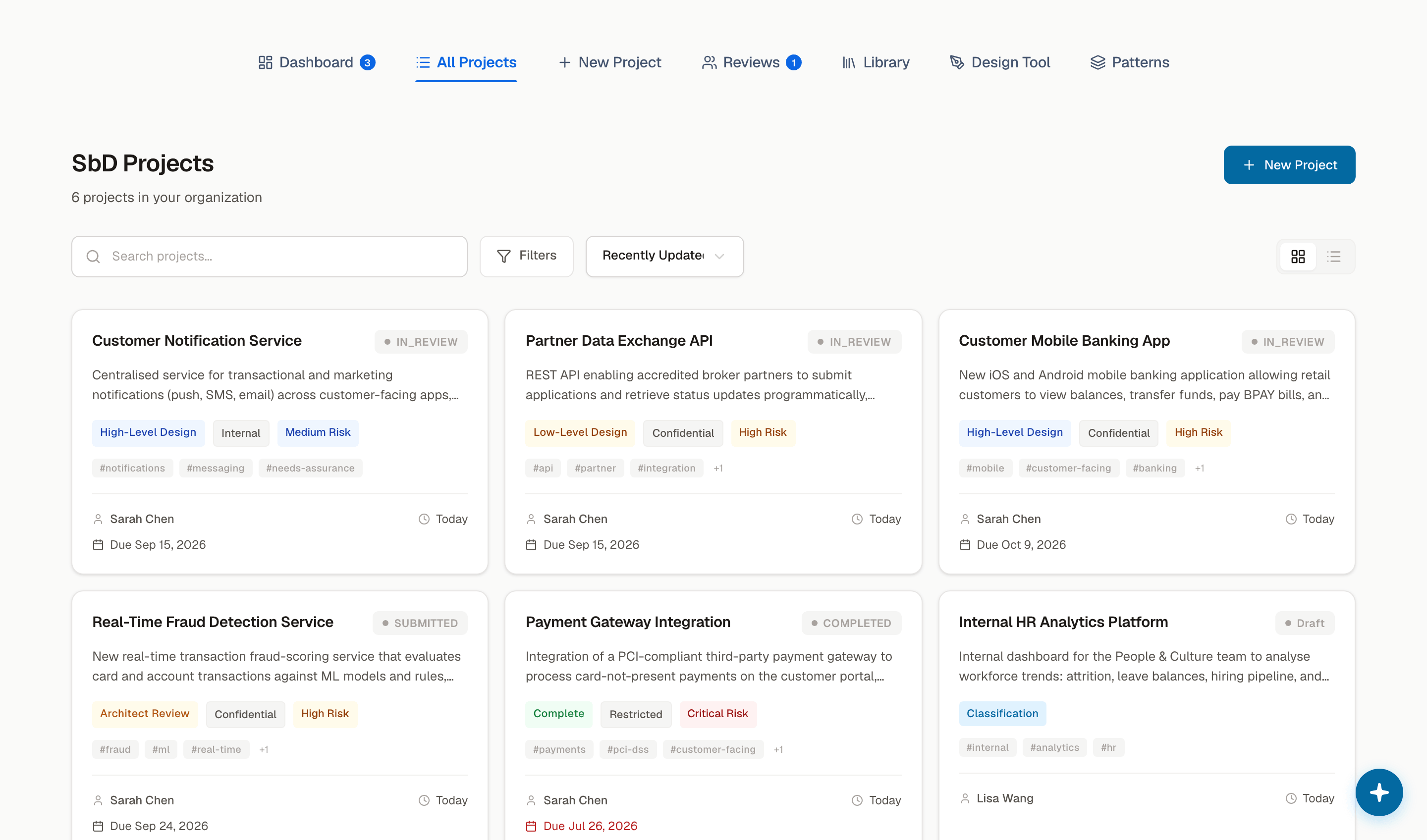
01 · The project list
Every design currently under review, in one list
One row per system or change being reviewed. Each shows the architect responsible, the stage it has reached, and how much the business would lose if it went wrong. Nothing sits waiting on someone who does not know it is theirs.
app.alvor.io/secure-by-design/projects
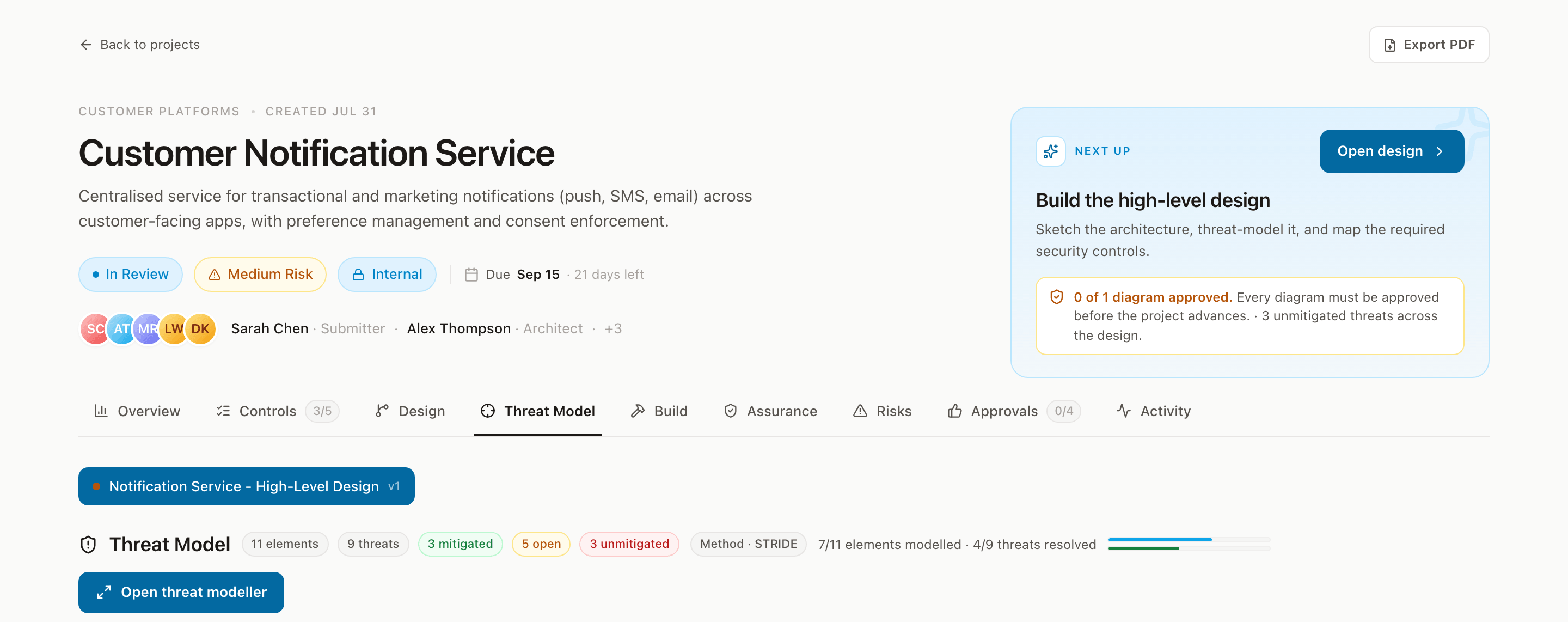
02 · The threat model
Every part of the diagram becomes something you can attack
Elements promoted straight off the architecture diagram, the threats recorded against them, and a running count of what is mitigated, open and still unaddressed. Try to mark a threat handled without naming a control that deals with it and the system refuses.
app.alvor.io/secure-by-design/threat-model
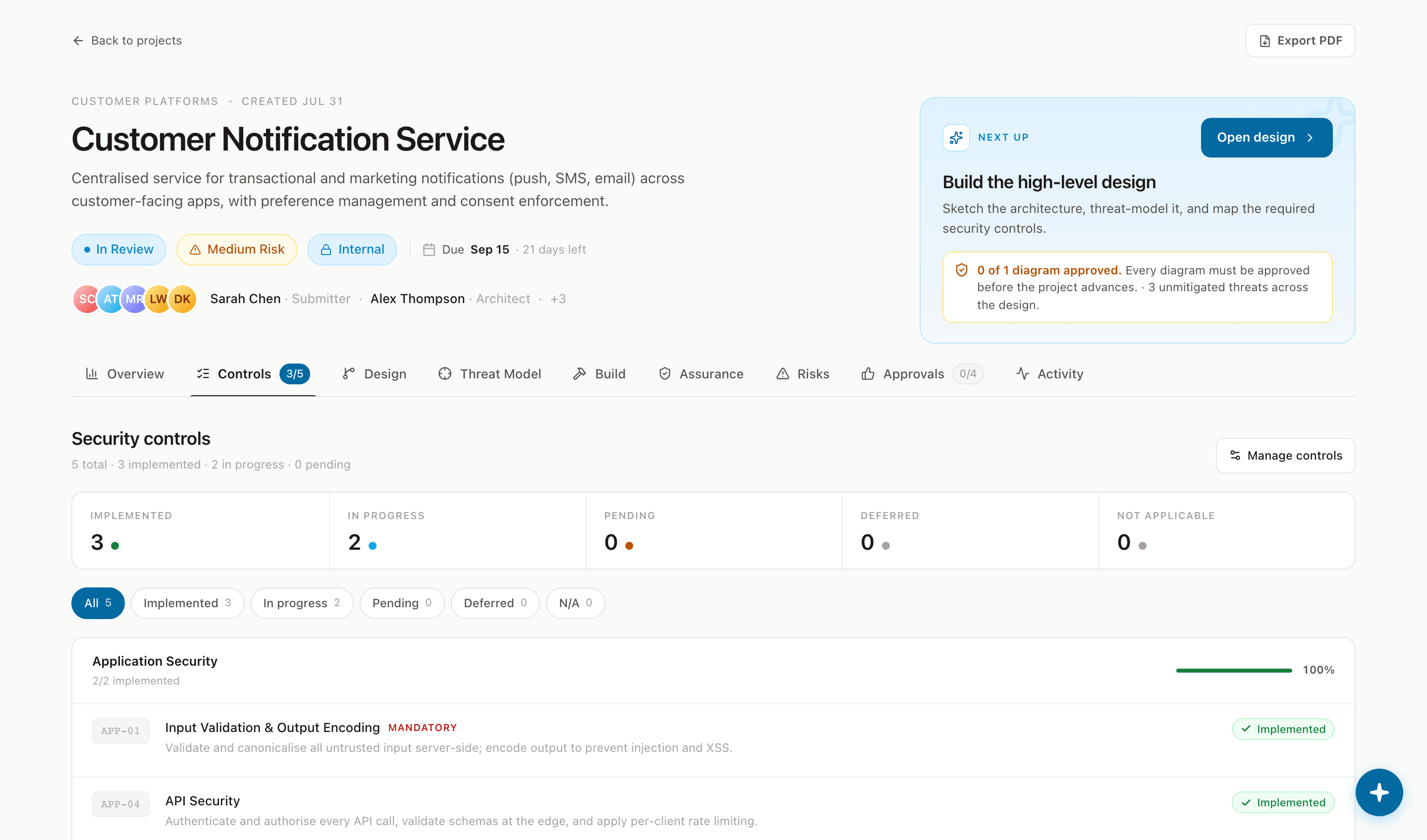
03 · The build
The security work arrives as tasks, with names against them
Every control chosen while threat modelling lands here on its own, carrying implementation status, an assignee, a due date and somewhere to attach the evidence. Nobody reconstructs the security requirements after the design is finished.
app.alvor.io/secure-by-design/controls
Risk intelligence
How much security does this project actually need?
Not every project needs a fortress. The Business Impact Assessment scores risk across five dimensions, then automatically determines classification, control depth, and assurance requirements. The right security for the right risk, every time.
Risk Classification
73 / 100
LowMediumHighCritical
Business Impact Assessment
Payment Gateway Upgrade
Operational
3/5MEDIUM
Health & Safety
1/5LOW
Reputation
3/5MEDIUM
Financial
4/5HIGH
Legal & Regulatory
4/5HIGH
Composite Score
0
High Risk
Tier 3 · Full review required
Architecture canvas
Your architecture, with security built into every line
Drag components onto an interactive canvas and watch security materialize. Every connection shows its protocol. Every node maps to its controls. Every data flow is visible, typed, and accounted for. This isn't a diagram, it's a living security model.
Drag & drop componentsLive control mappingProtocol visibility
Agentic studios
Three studios do the drafting on this canvas.
The AI assistant docks beside the work and builds the artefact with you: the diagram, the threat model, the design explanation. Every proposal waits for your approval, and everything it touches is audit-logged.
Design with AI
Describe the architecture. It draws.
Real, editable shapes on this canvas: zones, nodes, numbered flows, and a legend, laid out like a cloud reference architecture diagram. Paste a whiteboard photo and a vision model recreates it.
AI architecture diagramsModel with AI
The threat model, proposed for review.
It reads the diagram, registers STRIDE elements, proposes threats from your library, and maps mitigating controls. One approval card per batch; nothing lands without you.
AI threat modelingWrite with AI
The explanation, from an interview.
It describes what it sees, asks the team a few focused questions at a time, and writes the structured design explanation into the live editor for you to apply and save.
AI design documentsWhen the work is done, one click exports the full design document: project, people, business impact analysis, each diagram with its explanation, the threat model, and the sign-off matrix.
Meet the AI assistantApproval gates
Nothing ships without the right people saying yes
Four independent approvers, each with their own lens, their own decision, their own timestamp. This is where governance becomes permanent record.
Approved
Approved
Conditional
Pending
01
SA
Architect
Architecture reviewed. Controls verified.
Signed Feb 14, 2026 at 09:42
Audit trail
02
AT
Assurance
Pen tested. Scanned. Clean.
Signed Feb 18, 2026 at 14:15
Audit trail
03
BO
Business Owner
Risk R-2847 accepted. Rationale documented.
Signed Feb 20, 2026 at 11:33
Audit trail
04
TL
Technical Owner
Load test results outstanding.
Awaiting since Feb 20, 2026
Audit trail
Secure by Design, answered
How a design moves from intake to sign-off in Alvor.
Best for
Teams that review designs before they ship and want the review, the threat model, the controls and the sign-off to be one record.
What does the Secure by Design module do?
It runs the security architecture workflow as a governed program. A project starts with classification and a business impact analysis, moves through architecture design on a canvas, threat modeling on that diagram, control mapping, testing and evidence, and ends with named sign-offs before go-live. Every step has defined inputs and role-based gates, and every change is recorded in the event trail.
How does a threat model become build requirements and audit evidence?
Threats are anchored to elements on the design's own diagram. Each mapped control becomes a required, threat-driven build control on the project, so engineers see what to build and why. The controls are the same ones the Compliance module tracks, so their implementation and test evidence count toward the frameworks the organisation answers to. A threat that cannot be mitigated is accepted as a risk with an owner and a rationale, on the register rather than in a comment thread.
Who signs off, and what does the AI do?
Sign-off is by named people in the roles the project requires, recorded in the audit trail, and it stays human. The AI Design Studio draws the architecture as editable shapes from a description or a whiteboard photo, the AI Threat Modeling Studio proposes threats and controls in batches, and the design explanation is written by interview. Each of these pauses on an approval card before anything is written.
Can Secure by Design run on infrastructure we control?
Yes. The module runs in every deployment model: a dedicated cloud instance in your region, on-premise, or air-gapped, with the AI pointed at a self-hosted model if the network requires it.
What it replaces
Design review, included rather than bought separately.
The category sells design review as its own product, priced on its own. In Alvor it is a module of the platform you already run the program on.
Instead of
A standalone threat-modelling tool
Deep threat generation against a large component library. The output is a report.
In Alvor
The output is the project's control set, sitting in the build plan with an owner and a due date.
Instead of
A design review in a slide deck
Security sees the architecture two weeks before go-live, when every choice is already built.
In Alvor
A governed record from the first phase, with four named sign-offs and every post-baseline change classified.
Instead of
A diagram in a drawing tool
The picture and the decision drift apart the moment either one changes.
In Alvor
Versioned diagrams on a canvas whose shapes become the threat model, which becomes the controls.
How it connects
These are the exact links in the data model.
Named precisely, because “everything connects to everything” is not a claim anyone can check.
Secure by Design
Security that starts at the architecture layer, not the alert layer
Fixing a vulnerability in production costs 30× more than catching it at design time. Alvor gives your architects, engineers, and security team a shared workspace to review designs, model threats, and map controls before anything ships.