Asset Management
Most breaches start
with an asset nobody
knew existed
Alvor builds a living inventory across every environment, with an extensible set of built-in asset types plus custom types you define. Every asset is connected to the risks, policies, and compliance controls that depend on it.
Who it is for
You cannot protect what nobody has written down.
The security team
The register the rest of the program stands on.
- The types and relationships your estate actually uses, plus your own
- Vulnerability findings from your scanners attach to the asset they belong to
- Risks name the assets they affect, chosen by live search at intake
The engineering lead
The register fills itself from the tools you already run.
- Integration adapters pulling inventory in automatically
- GitHub and GitLab bring repositories in with their vulnerability findings
- AWS brings accounts, instances, databases, buckets, clusters and IAM principals
The asset owner
Ownership with a cadence, not a one-off spreadsheet exercise.
- Certification policies by type, criticality or department
- Campaigns with bulk certify, reminders and scheduled escalation
- A Continuity tab inheriting the strictest recovery objectives, with attribution
The product
What that looks like on screen.
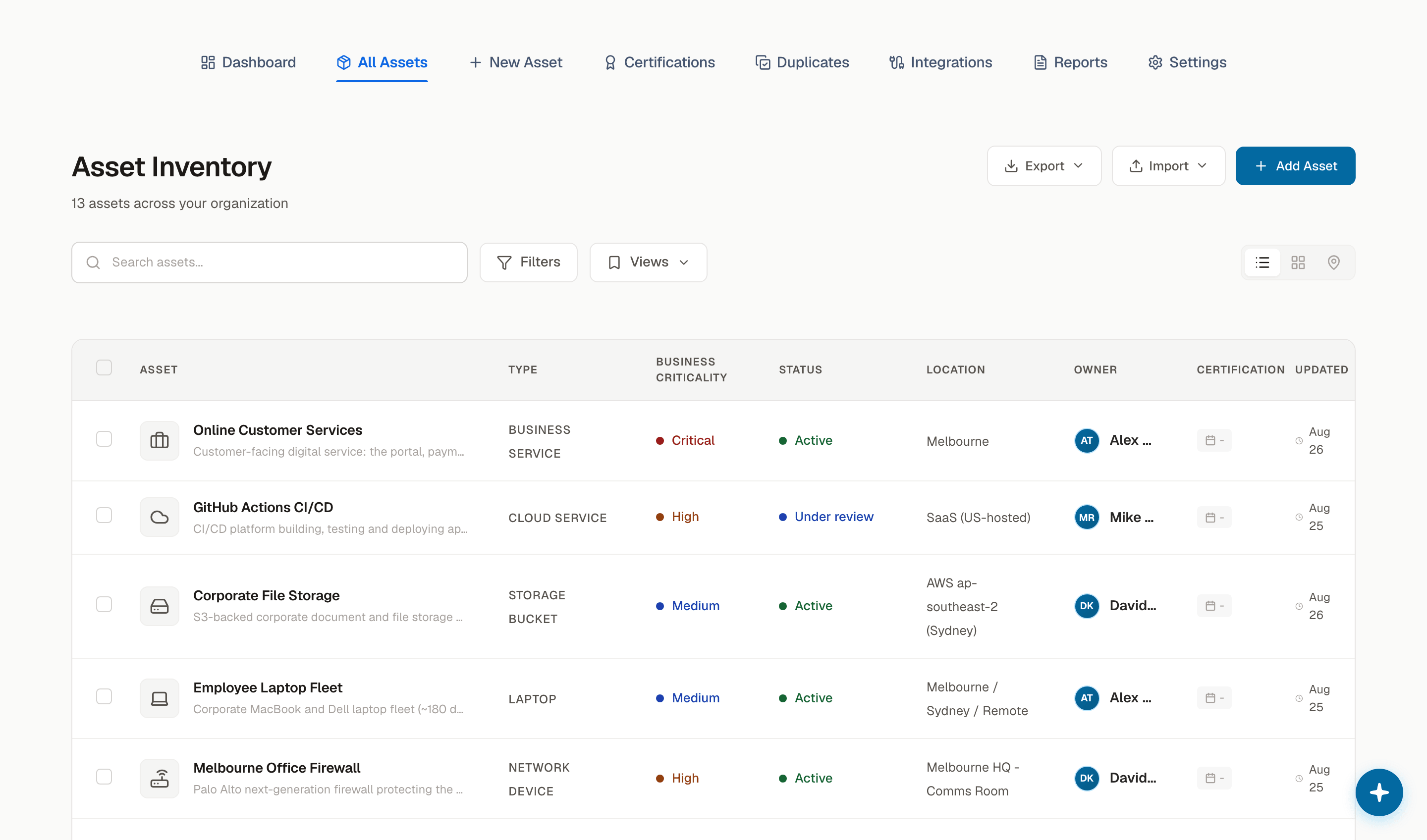
01 · The register
One inventory, across every environment you run
Cloud, code, endpoints and the things nobody automated, each with its type, business criticality, status, location and a named owner. Built-in types cover the usual estate and you can define your own when they do not fit.
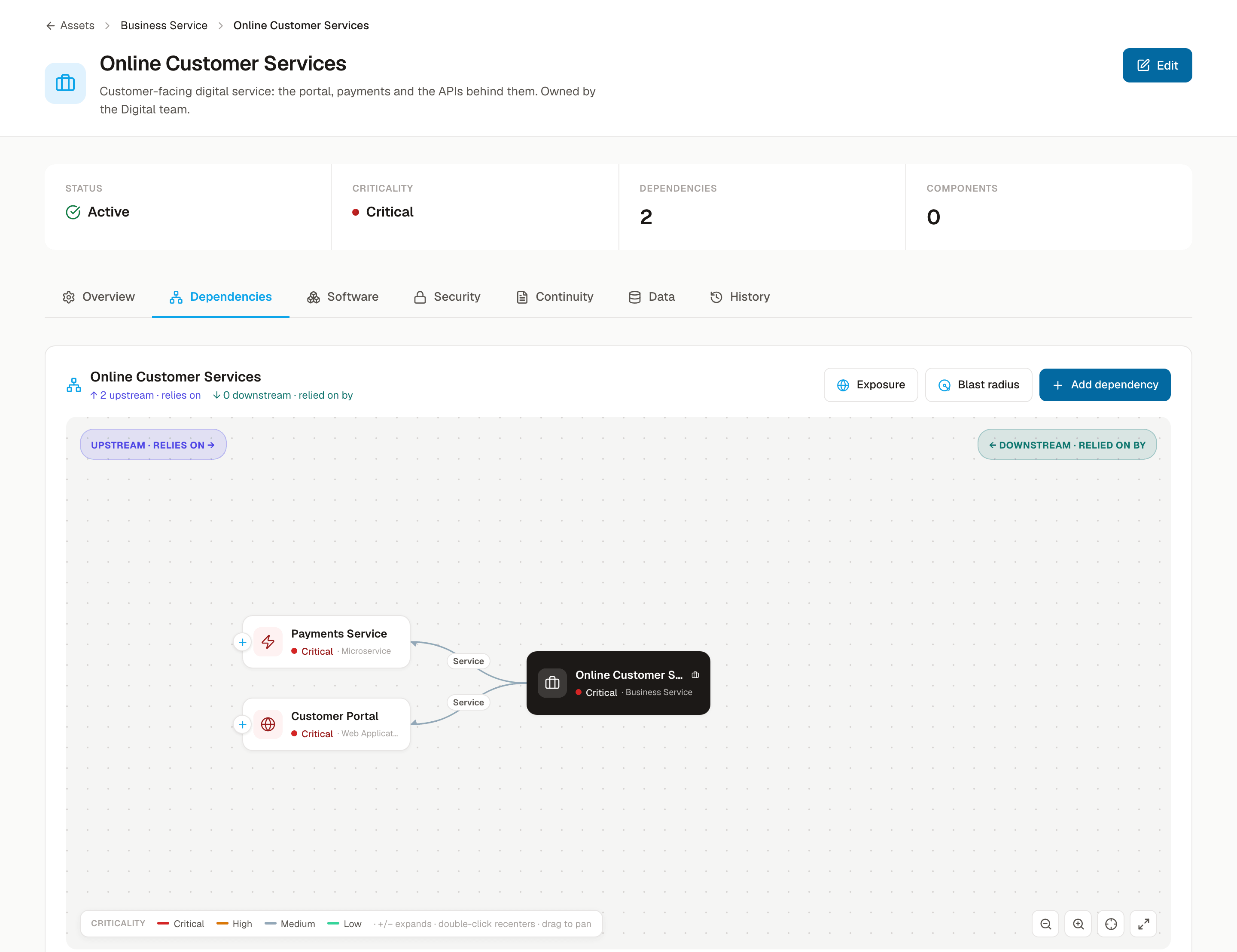
02 · A single asset
What it is, who owns it, and what breaks if it stops
Criticality and status up front, then a tab per question worth asking. Dependencies draws what this asset relies on and what relies on it, so the blast radius of an outage is something you can look at rather than reconstruct from memory.
The asset record
Each asset is one record with six parts.
Most platforms have an asset inventory. Alvor has an asset record: one entity with six dimensions, each cross-linked, each evidencing a different part of the security program.
app.example.com
Dimensions
6
Cross-linked into
Risk, Continuity, Secure by Design
Source of truth
One record
Overview
Status, criticality, ownership, and lifecycle. The header every other dimension reads from.
Security
Vulnerability findings from integrations and manual assessments. CWE references, severity, integration source, lifecycle state.
Four dimensions get dedicated landing pages because their categories warrant standalone consideration: dependency mapping, components, business continuity, and data governance. The other two live on the asset itself, where they belong.
Core capabilities
See every asset, with no blind spots
Continuous Discovery
Find every asset - managed or shadow, cloud or closet. Ingest via API integrations, CSV/JSON import, or manual entry.
Intelligent Classification
Tag each asset with criticality, data sensitivity, regulatory scope, and encryption status. Dual ownership baked in.
Full Lifecycle Tracking
Follow every asset from Plan through Acquire, Deploy, Operate, and Retire. No stale spreadsheet rows.
Data Governance
Attach governance records: data types (PII, PHI, PCI), retention periods, encryption, processing justification.
Automated Recertification
Campaigns on your schedule. Owners notified at 7, 3, and 1 day before deadlines. Overdue assets auto-escalate.
Dependency Mapping
Map upstream and downstream relationships between assets, services, and data flows.
How it works
Discover, classify, and certify.
DISCOVER
Find every asset, managed or shadow
Four ingestion paths ensure nothing hides. API integrations pull from Veracode, AWS, Azure, and GCP. Bulk CSV/JSON import handles legacy data. The REST API lets you build custom connectors.
- Veracode integration live - SAST, DAST, SCA findings auto-linked
- HMAC-SHA-256 authenticated sync with configurable schedules
- Extensible built-in asset types plus custom types you define, with rich field schemas
CLASSIFY
Context that outlives the person who entered it
Criticality levels, data classification tiers, encryption tracking, regulatory scope, dual ownership, and a flexible EAV architecture for custom fields.
- Criticality: Low, Medium, High, Critical
- Data classification: Public, Internal, Confidential, Restricted
- Lifecycle phases: Plan → Acquire → Deploy → Operate → Retire
CERTIFY
Recertification on your schedule
Certification campaigns run on your schedule - monthly, quarterly, annual, or custom. Owners are notified at 7, 3, and 1 day before the deadline. Overdue assets auto-escalate.
- Immediate or scheduled campaigns with configurable grace periods
- Auto-escalation after N days overdue to specified roles
- Full certification history: created, completed, extended, cancelled
The connective tissue
One asset record, linked to every module
In Alvor, every asset is natively linked to the modules that depend on it. A vulnerability flows to a risk, maps to a compliance control, triggers an action plan - all traced back to one record.
prod-db-primary
AWS RDS · us-east-1 · vpc-0a1b2c3d
3
linked risks
Risk
Criticality informs risk scoring. Impact analysis auto-links to affected assets.
12
controls mapped
Compliance
Evidence campaigns target asset groups. Scoring weighs inventory completeness.
5
design reviews
Secure by Design
Architecture diagrams reference asset nodes. Findings create linked risks.
8
active policies
Policy
Policies scope by asset type. Exceptions and acknowledgments target custodians.
Connects to your stack
Bring your tools and keep one inventory
Encrypted credential storage · Configurable sync schedules · Full audit trails
What it replaces
A register that maintains itself.
Asset inventories do not fail because nobody built one. They fail because nobody could keep it current.
Instead of
A CMDB nobody updates
Accurate the week it was built, and a work of fiction six months later.
In Alvor
Eight adapters pulling inventory from the tools you already run, plus certification campaigns that force a human check on a schedule.
Instead of
An asset list with no owner column
Everyone assumes somebody else is looking after it, so nobody is.
In Alvor
A named owner per asset, with reminders and escalation when a certification goes unanswered.
Instead of
Inventory that stops at the asset
You know the server exists. You do not know what would break without it.
In Alvor
Risks that name their affected assets, and continuity requirements inherited from the processes that depend on them.
How it connects
These are the exact links in the data model.
Named precisely, because “everything connects to everything” is not a claim anyone can check. Select any module to see its links.
Links the product makes today
Asset Management links to
Asset Management
Complete asset visibility - across every environment, automatically
Alvor builds a living inventory across an extensible set of built-in asset types, plus custom types you define. Every asset is automatically linked to the risks it carries, the policies that govern it, and the compliance controls that depend on it.